
Stand in the front window of a Valley View home and you can read most of Courtenay from one spot. The main city spreads out below: downtown’s five blocks of coffee shops, bookstores, and buildings that remember the last century, the Puntledge River threading through on its way to the estuary, and beyond it the west side neighbourhoods disappearing into big trees under the Beaufort Range. Behind you sits Crown Isle, fairways and executive homes in orderly rows, and around you the rest of East Courtenay: the hospital, the college, the subdivisions still adding streets.
If you’re considering a move to the Comox Valley from off-Island, Courtenay is usually where the search starts. It’s the valley’s largest city and its commercial centre, and it holds the widest range of housing, from walkable character homes to golf course executive builds to townhouses priced for a first purchase. But “Courtenay” on a listing tells you less than you’d think. The city is a collection of distinct neighbourhoods, and they suit different lives.
Here’s how a local would walk you through them.
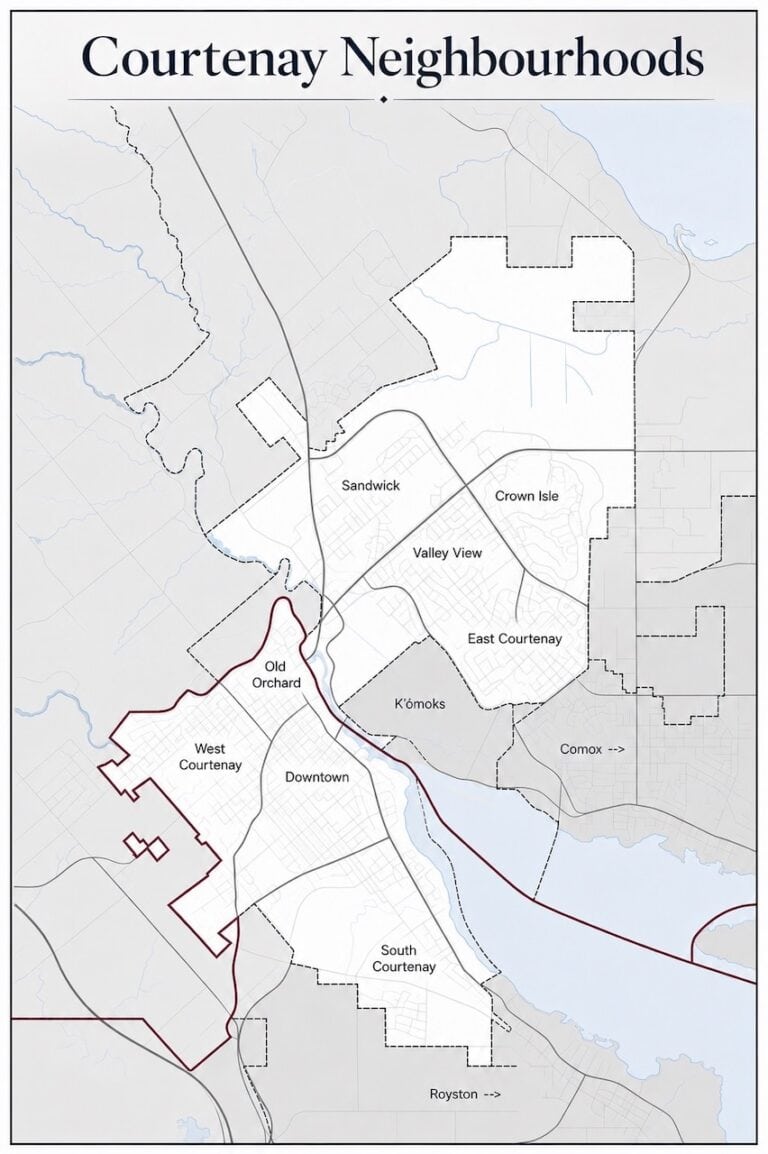
| Neighbourhood | Best For | Typical Housing |
|---|---|---|
| Downtown | Walkability | Infill and older homes |
| Old Orchard | Character | Heritage homes |
| West Courtenay | River lifestyle | Older detached homes |
| East Courtenay | Families | Newer detached & townhomes |
| Crown Isle | Golf & executive living | Executive homes, patio homes, condos |
| Sandwick | Space | Mixed homes & small acreages |
Downtown and Old Orchard
Downtown Courtenay is the valley’s closest thing to an urban core: independent shops and restaurants along 5th Street, the Sid Williams Theatre, the Courtenay and District Museum, and a growing number of condos and apartments above and around the commercial blocks. For buyers coming from a city who want to keep some version of a walking life, this is the neighbourhood that makes the transition gentle. Housing ranges from heritage homes surrounding downtown to condos, apartments, and townhomes, and the blocks around the core are seeing more infill development, with multi-unit townhouses, duplexes, and condos filling in lots that held single homes for decades.
Old Orchard sits just south of downtown, and it’s the neighbourhood people fall for on a first visit. Tree-lined streets, heritage homes, gardens that have had decades to mature, and the river a short walk away. It’s established, quiet, and close to everything, which is exactly why inventory is thin and character homes here carry a premium. When an Old Orchard house is done well, it often attracts multiple interested buyers.
West Courtenay: Puntledge Park and Arden
Head west from downtown and the pace changes. West Courtenay feels older in the best way: mature neighbourhoods beneath mature trees, with the river tying it all together. Puntledge Park itself is the anchor, and in summer the swimming holes along the river are where half the town cools off. Lewis Park and Simms Millennium Park follow the river toward the estuary, now two minutes from downtown on foot thanks to the new bridge.
Housing on the west side runs from wartime-era homes on generous lots to solid 1970s and 1980s family houses, with renovation stories on every street. Arden, further out toward the valley’s western edge, starts to feel semi-rural: bigger properties, quieter roads, and the trailheads closer than the shops. West side buyers tend to be people who want trees and river access more than they want a new kitchen, though increasingly the renovated homes here offer both.
East Courtenay: the newer city
East Courtenay is where most of the city’s growth has gone for the past two decades, and it’s the practical choice on several fronts. North Island Hospital, Comox Valley campus, is here, along with North Island College, the big-box shopping, and quick access to the inland highway for trips up or down Island. Neighbourhoods like Aberdeen Heights and South Lerwick offer newer construction, from townhomes to family houses, on a street grid that was planned rather than accumulated.
Valley View deserves its own mention. Perched on the hill above the river, it holds arguably the best views in the city, looking west across downtown to the Beaufort Range, and homes with that outlook rarely stay quiet on the market.
This is the side of town that suits families who want newer systems and fewer maintenance surprises, professionals working at the hospital, and buyers who’d rather spend weekends somewhere other than a renovation. East Courtenay’s older pockets also contain some of Courtenay’s larger residential lots, which in some cases have become more interesting since the city’s small-scale multi-unit housing zoning changes. If a multigenerational setup is part of your thinking, the east side is where those conversations tend to happen.
Crown Isle
Crown Isle is its own category: a master-planned community built around an 18-hole championship golf course, with executive homes, a well-kept streetscape, and covenants that keep it that way. While best known for executive detached homes, Crown Isle also includes patio homes, townhouses, and condominiums. It sits at the upper end of the Courtenay market, and it attracts a particular buyer: often retirees or near-retirees arriving with equity from a larger market, looking for a newer home where the standard of the whole neighbourhood is part of what they’re buying. The clubhouse operates as a social hub, and the location puts the hospital, shopping, and the highway minutes away.
Buyers relocating from larger Canadian cities often find Crown Isle familiar in the best sense: newer homes, consistent streetscapes, and a level of finish comparable to master-planned communities elsewhere.
Sandwick and the Mission Road area
Between the east side’s subdivisions and the city’s rural edges sit transitional pockets like Sandwick and the Mission Road area, where lot sizes grow, sidewalks thin out, and the housing stock gets more varied: older farmhouses, 1990s builds, small acreages on the edge of the city. These pockets suit buyers who want breathing room without committing to a fully rural property, and they’re worth watching because they don’t fit tidy categories, which sometimes means value the market hasn’t fully priced.
South Courtenay and the Fraser Road area
South Courtenay is the city’s newest growth front, and The Ridge is its anchor: a master-planned community of more than 300 homes overlooking Comox Harbour, bounded by Fraser Road, Buckstone Road, and Comox Logging Road. The land was annexed into the city in 2007, and the build-out has been steady since, with newer phases taking access from Fraser Road. The streets are deliberately narrow with pedestrian boulevards, a greenway network runs through the site, and the harbour views from the upper lots are among the best new-construction views in the valley. It suits buyers who want a new home without committing to the east side’s busier commercial orbit, with Royston and Cumberland minutes away.
The practical picture
A few things that apply across all of it.
The market, in one paragraph. The Comox Valley in mid-2026 is a more balanced market than the peak years, with more inventory and more room for buyers to breathe. Well-priced homes in the established neighbourhoods still move with conviction, and the entry points vary widely: strata options downtown and on the east side sit well below the detached market, character neighbourhoods carry a premium, and Crown Isle tops the range. For current numbers, the monthly Market Snapshot on this blog carries them so this guide doesn’t have to age.
Getting around. Courtenay is compact. Most cross-town drives are under fifteen minutes, and the city’s active transportation network keeps improving; the 6th Street pedestrian bridge is the most visible recent piece. Mount Washington’s ski hill is about forty minutes up the road, Comox Lake about fifteen, and the beaches of Comox minutes away.
Schools and services. Catchments are important to relocating families and deserve their own post (it’s coming). The short version: the valley’s schools are distributed such that every Courtenay neighbourhood has elementary options close by, and the hospital’s east side location is a factor for anyone whose work or health care needs make proximity valuable.
Every one of these neighbourhoods can be the right answer. The work is matching the neighbourhood to the life you’re actually planning to live here, and that’s a conversation I’m always glad to have. If you’re weighing a move to the valley, get in touch, and if you want the market numbers monthly, the Snapshot lands in your inbox with no pitch attached.
This guide reflects the Comox Valley market as of July 2026. Neighbourhood boundaries are informal and locals will happily argue about them.